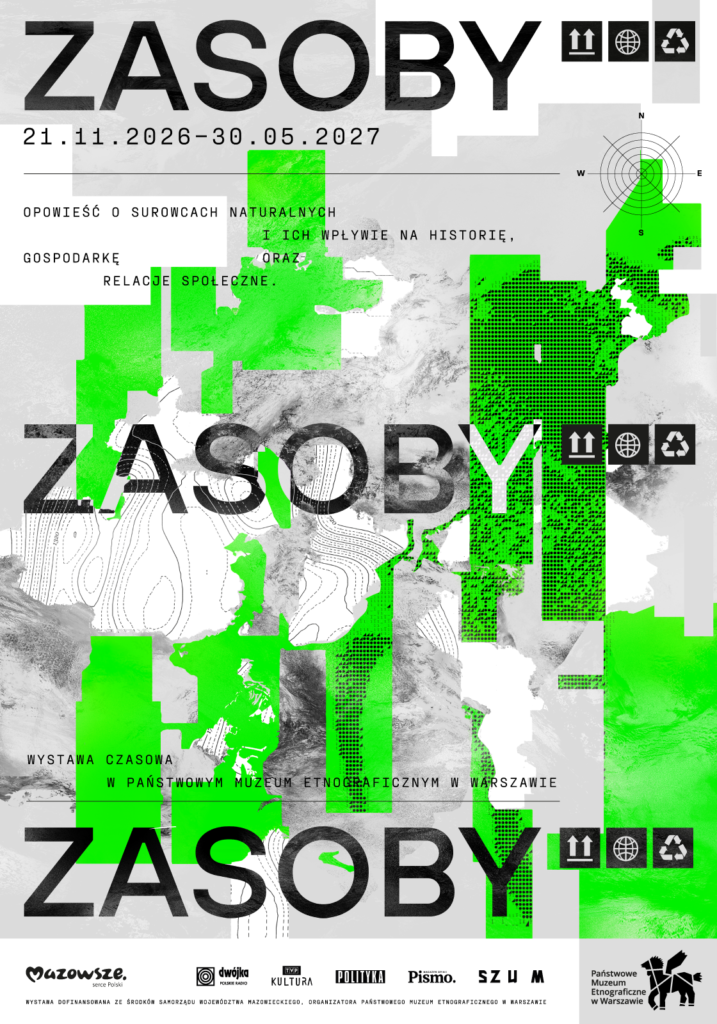
Everyday objects begin as raw material – extracted, cut down, or cultivated. Within them lie traces of the processes that shape the modern world. The “Resources” exhibition prompts the questions: who has the right to these resources, who profits from them, and who pays the highest cost from their extraction.
Difficult histories hidden in plain sight
What links a Polish church fair gingerbread, an American housewife’s kitchen sign, and Fidel Castro’s Cuban machete? “Resources” juxtaposes objects from across all collections of the State Ethnographic Museum in Warsaw. The exhibition departs from the neutrality of objects, revealing their obscure and often dark origin.
The core of this narrative is a critique of extractivism as a model of unrestrained resource exploitation. It exposes violence, social inequalities, and environmental degradation, highlighting the striking continuity of these phenomena – from the era of colonial conquest, through the industrial revolution, to the present day.
An alternative map of the world and voices of resistance
Mines, plantations, and transport routes form a complex network of global dependencies. The exhibition offers an alternative vision of world cartography – one based not on political borders, but on economic, ecological, and social relations.
“Resources” focuses on ten natural raw materials, such as cobalt, sugar, silk, and crude oil. Each has a dedicated “island” featuring texts, objects, data, tactile elements, and recordings of activists and researchers working on sites connected to their extraction.
Giving voice to these individuals highlights both the scale of contemporary crises and potential ways of confronting them – collaboration, mutual care, and shared responsibility for our common future.
The “Resources” programme
“Resources” is part of an exhibition programme of the same title, which also includes two temporary exhibitions: “Everything Will Change” (an outdoor exhibition, 4 June – 27 October 2026) and “Whose Land?” (21 November 2026 – 30 May 2027). Each exhibition approaches the theme of extractivism from a different perspective.
Exhibition Accessibility
The exhibition features:
- texts in Polish and English,
- audio descriptions of the entire exhibition and selected objects in Polish and English,
- tactile graphics of selected objects,
- a video guide to the exhibition and information in Polish Sign Language (PJM),
- information in Plain Language,
- seating areas for rest,
- texts with appropriately sized fonts to ensure comfortable reading for a wide range of visitors.
The selection of content adapted into accessible formats was made through a consultation process that took into account the perspectives of self-advocates.
Exhibition Credits
Director of the State Ethnographic Museum in Warsaw: dr Magdalena Wróblewska
Exhibition coordination: dr Maria Wodzińska
Curators and authors of texts: Joanna Barczuk, Katarzyna Flis, Agnieszka Grabowska, Agnieszka Kleszcz, Małgorzata Kunecka, Patryk Pawlaczyk, Mariusz Raniszewski, Amudena Rutkowska, dr Marta Skwirowska, dr Maria Wodzińska
Individuals and organisations – advocates and self-advocates: Björn Alpermann – Coal Action Network, Piotr Bednarek – Wolne Rzeki, Marta Jagusztyn – Lasy i Obywatele, Chandan Kumar – Indian Sugar Industry Workers Association, Rhea Lopez – India Sand Watch, Luis Alberto Meléndez Guerrero, Patience Mususa – Nordic Africa Institute, dr Emem Okon – Kebetkache Women Development and Resource Center, Daniel Therkelsen, Emmanuel Umpula – AfreWatch, Uzbek Forum for Human Rights
Exhibition design: Anna Sarnowska, Natalia Wojciechowska
Visual identification, graphic design: Alina Rybacka-Gruszczyńska
Map development: Filip Wesołowski
Translation: Bartosz Wójcik
Conservation and circulation of exhibits: Marcin Burzymowski, Kateryna Havrylenko, Marianna Koźmińska, Anna Wąsek-Głowacka
Accompanying events: Justyna Dominiak, Julia Grudzień, Zofia Herman-Templewicz, Joanna Migut, Luxuan Wang
Accessibility: Julianna Chrzanowska, Monika Dubiel, Artur Piwowarski, Emilia Szuchniewicz, Wielozmysły, Justyna Zieniuk
Financial coordination: Kamila Smakulska-Kurek
Process coordination: Aleksandra Ochała
Technical team and organisational assistance: Marcin Kiersnowski, Kamila Końska, Piotr Maciukiewicz, Łukasz Malinowski, Monika Roguska, Tomasz Rychter, Zenon Winnicki
PR and communication: Patrycja Chybowska, Łukasz Gackowski, Marta Matysiak, Jakub Nowociński, Przemysław Walczak
Media Partners



The exhibition is co-financed by the Mazovian Voivodeship Government, the organiser of the State Ethnographic Museum in Warsaw.


