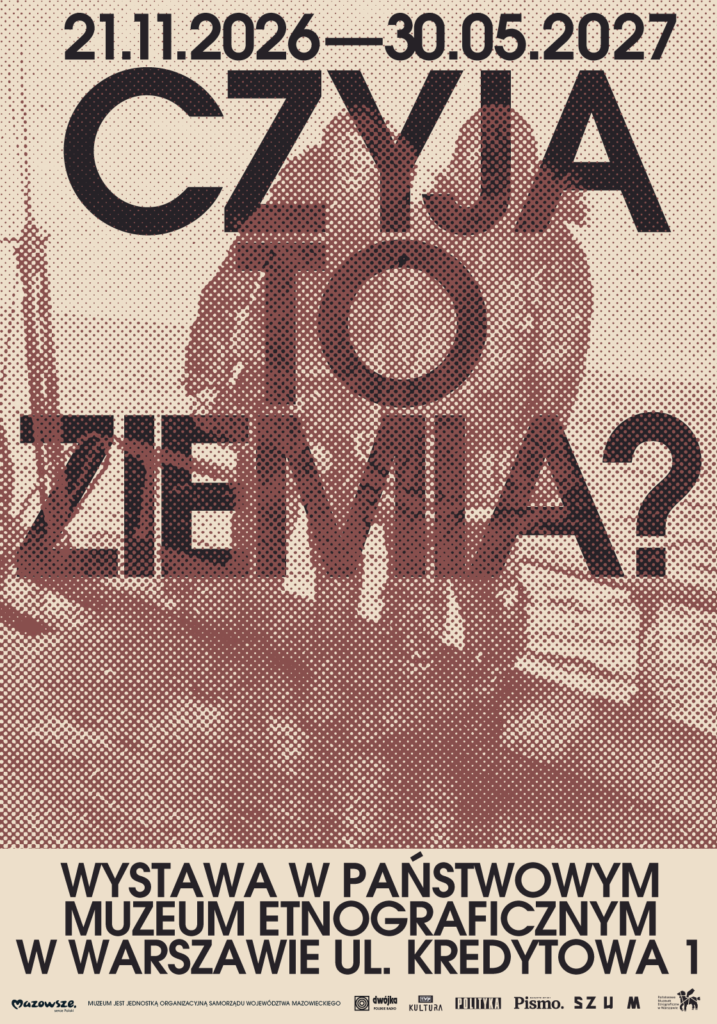
Can land be owned? The exhibition “Whose Land?” examines the mechanisms of settler colonialism through the lens of early 20th century Alaska and Siberia – an era defined by gold rushes and intense colonial developments.
This land is not empty
The exhibition displays photographs and walrus ivory carvings from the collections of the State Ethnographic Museum in Warsaw as its point of departure. The collection traces how photography and collecting helped construct depictions of the world.
The photographs on display frequently portray Alaska and Siberia as “empty land.” These territories were treated as a resource to be appropriated, named, and repurposed to meet settler needs. In reality, they had been inhabited for generations by communities whose lives and environments were abruptly subordinated to imperial interests.
A rifle in one hand, a camera in the other
The exhibition features photographs of Indigenous communities, primarily the Inuit and the Chukchi. Images of barren landscapes and of people who inhabit these regions are not opposites, even if they might appear to be. Rather, they function as complementary elements of colonial representational systems, binding people and land into a single narrative. In doing so, the exhibition demonstrates that photography was never neutral.
From colonialism to the present day
“Whose Land?” poses its question and points to both the historical legacies of colonialism and the continuity of the mechanisms that govern the modern world. Land and its resources remain subjects of ongoing appropriation – from gold rushes to contemporary extractivism. This exploitation continues to happen at the expense of local communities, non-human animals, and the natural environment.
The “Resources” programme
“Whose Land?” is part of an exhibition programme that also includes two temporary exhibitions: “Everything Will Change” (an outdoor exhibition, 4 June – 27 October 2026) and “Resources” (21 November 2026 – 30 May 2027). Each exhibition approaches the concept of extractivism – as an unrestrained model of resource exploitation – from a distinct perspective.
Exhibition Accessibility
The exhibition features:
- texts in Polish and English,
- audio descriptions of the entire exhibition and selected objects in Polish and English,
- tactile graphics of selected objects,
- a video guide to the exhibition and information in Polish Sign Language (PJM),
- information in Plain Language,
- seating areas for rest,
- texts in appropriately sized fonts to ensure comfortable reading for a wide range of visitors.
The selection of content adapted into accessible formats was made through a consultation process that took into account the perspectives of self-advocates.
Exhibition Credits
Director of the State Ethnographic Museum in Warsaw: dr Magdalena Wróblewska
Curator and author of texts: Julia Grudzień
Project coordination: Justyna Dominiak
Exhibition design: Anna Sarnowska, Natalia Wojciechowska
Visual identification and typesetting: Karolina Pietrzyk, Tobias Wenig
Translation: Bartosz Wójcik
Conservatorial care: Marcin Burzymowski, Kateryna Havrylenko, Marianna Koźmińska, Anna Wąsek-Głowacka
Compiling and digitization of archive materials: Joanna Bartuszek, Alicja Kobus
Accompanying events: Justyna Dominiak, Julia Grudzień, Zofia Herman-Templewicz, Joanna Migut, Luxuan Wang
Accessibility: Julianna Chrzanowska, Monika Dubiel, Artur Piwowarski, Emilia Szuchniewicz, Wielozmysły, Justyna Zieniuk
Process coordination: Aleksandra Ochała
Technical team and organisational assistance: Marcin Kiersnowski, Kamila Końska, Piotr Maciukiewicz, Łukasz Malinowski, Monika Roguska, Tomasz Rychter, Zenon Winnicki
PR and communication: Patrycja Chybowska, Łukasz Gackowski, Marta Matysiak, Jakub Nowociński, Przemysław Walczak
Media Partners



The Museum is an organisational unit of the Mazovian Voivodeship Government.


